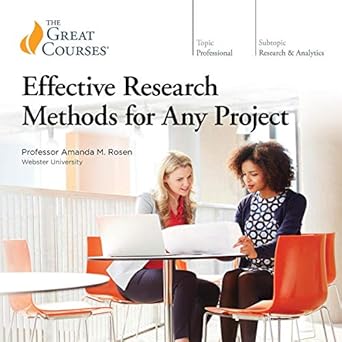
The Great Courses - Effective Research Methods for Any Project - Amanda M. Rosen, PhD
Shared by:ihophats
Written by ,
Read by Amanda M. Rosen, PhD
Format: MP3
Bitrate: 64 Kbps
Unabridged
Length: 12 hrs and 9 mins
Release date: 02-01-19
We live in a world of information. The sheer wealth of data available to us is exciting but also overwhelming. How do we separate truth from fiction? Where do we look for reliable sources? What products are best and what studies are accurate? Which headlines can be trusted?
Sound, systematic research underlies much of what is best about our world. When we think of achievements in medicine, the sciences, engineering, architecture, product design and safety, and so much more, these are areas of endeavor that depend on careful and rigorous research for their effectiveness. We rely on the fact that these areas would have undergone effective research, because sometimes our well-being and our lives depend on it.
Research, of course, is not only for scientists and scholars. Almost everyone does some kind of research from time to time. Whether you are going online to decide about an important purchase, considering a choice between schools and universities, solving a medical problem, making a career decision, or even to planning a vacation, effective research is indispensable to us in many aspects of daily life.
But what makes research effective and what allows it to give us valid and useable results?
Any good research rests upon, above all else, method. Having a systematic, reliable approach to answering a question or investigating something important lies at the heart of valid research and the knowledge it produces. Methodology is what makes the study of research methods both highly useful and deeply fascinating—it helps us see the inner workings of how knowledge is created.
In the 24 engaging and detailed lectures of Effective Research Methods for Any Project, you’ll discover the remarkable methods and techniques that make research such a powerful tool in so many areas of life. Taught by political scientist and research methods expert Professor Amanda M. Rosen of Webster University, this course gives you a deep, detailed, and practical guide to proper research methods, ones that are broadly applicable to all kinds of research. And, once you understand how sound research is conducted, you will also have an invaluable tool for determining which sources, methods, and studies are to be trusted as you encounter them in both your personal and professional life.
Learn the Core Techniques and Applications of Sound Research
Throughout this course, Professor Rosen introduces you to the wide range of research techniques that are available, equipping you to tackle your own projects. You’ll study the procedures and methodologies of experiments, quasi experiments, survey research, case studies, focus groups, election polling, ethnography, and more. And you’ll do this by employing the scientific method. While most of us learned the scientific method in school, here you will learn how to apply its principles to the information you encounter every day. The process will help get you from whatever research question you might have to an answer, regardless of your discipline, profession, or topic of study.
The lectures are designed to help you conduct research on any project. With that aim in mind, you’ll consider examples and techniques from many different fields, such as psychology, business, journalism, medical research, politics, sociology, and other areas, including everyday matters and problems.
Professor Rosen presents a rich and multilevel resource for developing your research project, allowing you to draw on the material and subject matter most appropriate to your specific study. She also makes it clear that research methods are truly usable by anyone. Even if you have no background in math or science, you can master these procedures and use them to find the answers and information you’ve been looking for.
Grasp the Foundations of Credible Research
You’ll begin by taking a broad and deep look at the features of sound research, what defines it, and how to evaluate the research of others. In laying the groundwork for your own research project, you’ll investigate:
The standards, principles, and regulations regarding ethics in research, and the phenomenon of ethical review boards;
The vital role of a review of the scholarly literature as a preparatory step in your research process;
How to develop both a topic for your research and a core research question to guide your work, two essential aspects of a workable research project;
The varieties of research design that exist, and how to choose the best research design for your project;
How to measure your data, encompassing four principle levels of measurement; and
How to define the population of data points you’ll be looking at in your project, and how to select the sample of this population you will actually study.
Ground Yourself in the Range of Research Methodologies
You’ll follow the fundamentals of sound research with a detailed study of the most important categories of research design and methodology. Among these, you’ll explore:
The Classic Experiment—Take account of the philosophy and procedure of the classic or “true” experiment, the hallmark of research in the natural sciences and medicine; learn how to use this methodology, and how it maximizes the control you have over your subjects and variables;
Surveys—In two lectures on survey research, grasp how surveys are used to reveal the characteristics of a given population; learn to design and run a survey, and construct survey questions; also study election polling, and how to discern which polls you can trust;
Case Studies—Delve into the workings of the case study, which analyzes data from a small group of cases, and is often applied in business, law, the social sciences, and medicine; note how case studies are used, and how to choose your cases for a case study project;
Field Research—Observe how field research often uses an “interpretivist” approach, involving subjective interpretation of data; take a deep look at the use of interviews and how to conduct them, and at observation research, which observes the behavior of subjects in the field;
Action Research—Within the category of applied research, which uses research findings in problem-solving, investigate action research, which seeks collaborative solutions to real-world problems, usually with researchers working in tandem with community members.
Learn to Analyze Your Data and Communicate your Findings
Finally, you’ll look in-depth at how to process, analyze, and share your data. First, you’ll study quantitative data analysis, interpreting your findings through simple statistical calculations that describe your data in useful ways. You’ll learn how inferential statistics allow you to draw conclusions from your data, and to compare groups using statistical means. And you’ll learn vital methods such as how to track the correlation or relationship between your data variables, and how to assess causation between your variables. You’ll also study qualitative data analysis, which involves discerning meaning and patterns in data, and the principle approaches to qualitative analysis you may need for your research. And you’ll learn how to share your findings, from the formal research report to less systematic approaches.
Throughout the lectures, Professor Rosen’s teaching style makes this an accessible and highly enjoyable learning experience. Her very clear description of concepts, often-humorous perspective, and use of real-world examples bring the subject matter vividly alive. You’ll delve into compelling examples of research, ranging from the landmark study of social discrimination by Jane Elliott and the work of anthropologist Clifford Geertz on Balinese culture to the polling debacle of the 2016 U.S. presidential election.
Effective Research Methods for Any Project takes you deeply into the world of the researcher, both in theory and in hands-on practice. Through these 24 lessons, you’ll gain real skill with this practical and transformative approach to knowledge creation.

| Announce URL: | |
| This Torrent also has several backup trackers | |
| Tracker: | udp://tracker.open-internet.nl:6969/announce |
| Tracker: | udp://tracker.opentrackr.org:1337/announce |
| Tracker: | udp://tracker.tiny-vps.com:6969/announce |
| Tracker: | udp://tracker.vanitycore.co:6969/announce |
| Tracker: | udp://tracker.torrent.eu.org:451/announce |
| Tracker: | http://tracker.internetwarriors.net:1337/announce |
| Tracker: | http://tracker.vanitycore.co:6969/announce |
| Tracker: | http://retracker.telecom.by/announce |
| Tracker: | udp://tracker.leechers-paradise.org:6969 |
| Tracker: | udp://tracker.coppersurfer.tk:6969 |
| Tracker: | udp://open.demonii.si:1337/announce |
| Tracker: | udp://thetracker.org:80/announce |
| Tracker: | http://tracker2.dler.org:80/announce |
| Creation Date: | Wed, 01 May 2019 17:34:53 +0100 |
| This is a Multifile Torrent | |
| 01. Why Research Methods Matter.mp3 18.5 MBs | |
| 02. Characteristics of Good Research.mp3 16.97 MBs | |
| 03. Doing Research Ethically.mp3 16.14 MBs | |
| 04. From Topic of Interest to Research Question.mp3 18.12 MBs | |
| 05. What’s Already Known The Literature Review.mp3 17.44 MBs | |
| 06. Generating Hypotheses and Theories.mp3 19.43 MBs | |
| 07. Selecting a Research Design.mp3 16.98 MBs | |
| 08. Measuring Concepts and Phenomena.mp3 18.58 MBs | |
| 09. Choosing Populations, Samples, and Cases.mp3 16.88 MBs | |
| 10. The Classic Experiment.mp3 17.48 MBs | |
| 11. The Value of Quasi Experiments.mp3 17.34 MBs | |
| 12. Designing and Conducting a Survey.mp3 17.37 MBs | |
| 13. Understanding Election Polls.mp3 18.15 MBs | |
| 14. Research by Case Study.mp3 16.5 MBs | |
| 15. Interpretivism and Field Research.mp3 16.44 MBs | |
| 16. Applied, Evaluative, and Action Research.mp3 15.83 MBs | |
| 17. Gathering and Preparing Data.mp3 17.41 MBs | |
| 18. Using Statistics to Interpret Data.mp3 17.9 MBs | |
| 19. Statistical Inferences from Data.mp3 16.79 MBs | |
| 20. Assessing Correlation and Causation.mp3 17.53 MBs | |
| 2024_ResearchMethods.pdf 23.69 MBs | |
| 21. From Bivariate to Multivariate Analysis.mp3 17.58 MBs | |
| 22. Foundations of Qualitative Analysis.mp3 17.63 MBs | |
| 23. Qualitative Analysis Variations.mp3 16.59 MBs | |
| 24. The Art of Presenting Your Findings.mp3 18.06 MBs | |
| Combined File Size: | 441.34 MBs |
| Piece Size: | 256 KBs |
| Comment: | Updated by AudioBook Bay |
| Encoding: | UTF-8 |
| Info Hash: | 3c9b6641b13f33f3ad51a64f6bafa1e5b6a669f6 |
| Torrent Download | Torrent Free Downloads |
| Tips | Sometimes the torrent health info isn’t accurate, so you can download the file and check it out or try the following downloads. |
| Direct Download | Start Direct Download |
| Tips | You could try out alternative bittorrent clients. |
| Secured Download | Download Files Now |
| Ad |

|


This post has 5 comments
May 14th, 2019
On behalf of all undergraduate psych majors I thank you.
September 19th, 2022
seed pls
March 13th, 2026
Seed please
March 16th, 2026
My progress is stuck at 95.3…can someone seed
March 16th, 2026
My progress is stuck at 95.3…
Add a comment (please log in before commenting)