The Great Courses - Long Shadow of the Ancient Greek World - Ian Worthington, Ph.D.
Shared by:ihophats
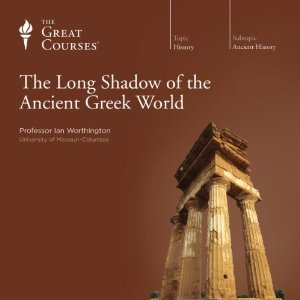
Written by ,
Read by Ian Worthington, Ph.D.
Format: MP3
Bitrate: 64 Kbps
Unabridged
Length: 25 hrs
Release date: 07-08-13
300 Spartans guarding the pass at Thermopylae. Socrates, Plato, and Aristotle engaging in a dialogue that will give birth to Western philosophy. Alexander the Great conquering nearly the entire ancient world. The military and political history of ancient Greece is famously endowed with stirring scenes such as these. But Greek history is much more than a series of gripping set pieces.
The four centuries that saw the remarkable rise of Greek civilization tell a complex story about the growth of the institutions that laid the foundations for Western civilization.
Traditions that we take for granted today—including open political debate, trial by jury, and the concept of the social contract—were born and reached a vigorous maturity during this era. Not only do the traditions of democracy, law, and empire connect the ancient world with the modern, they also tell us more about the Greeks than any other aspect of their society, including their celebrated artistic and cultural achievements.
The Long Shadow of the Ancient Greek World immerses you in this exciting crucible of innovation in 48 fascinating lectures that focus on Greek democracy, law, and empire, as well as the people who molded them during the Archaic and Classical periods. Taught by award-winning scholar and educator Ian Worthington of the University of Missouri–Columbia, this comprehensive course takes you from 750 to 323 B.C.—a span of history that contains the emergence of Greece at the end of the Dark Ages and the final disintegration of Greek autonomy through the Macedonian kings Philip II and Alexander the Great.
Hard-Fought Struggles
Concentrating on the city-states of mainland Greece, with a special focus on Athens, The Long Shadow of the Ancient Greek World takes you through some of history’s most hard-fought struggles—from armed conflicts (such as the Persian Wars, the Peloponnesian War, and the campaigns of Alexander the Great) to political and social struggles (including the late 6th-century civil war in Athens that pitted nobles against the lower classes and eventually produced the first stirrings of democracy).
This course, which covers more than three centuries of rich Athenian and Greek history, is an incredibly detailed look at the birth and maturation of our modern law and democracy. As you explore innovative Athenian approaches to law and empire, you discover how these approaches served as the bedrock for ideas and practices that you live with every day. You also encounter a wealth of intriguing links to many of our own contemporary institutions and attitudes:
Democracy: Ancient democracy, like its modern form, was more than a matter of showing up at an assembly to cast a vote. The practice had a complex structure from the start, along with an ever-changing system of checks and balances.
Law: Trial by jury was an invention of Athenian lawgivers, as was arbitration and the right of appeal. According to Professor Worthington, even lawyers originated in Athens in the form of professionals who were hired to write and deliver speeches in the courts.
Empire: The age that produced Alexander the Great, whose sprawling empire disintegrated after his death, holds lessons about the danger of imperial overreach. By contrast, Alexander’s father Philip II knew how to conquer—and how to negotiate and compromise as well.
Explore a Time of Exciting Developments
The Long Shadow of the Ancient Greek World begins with a strong background on the Bronze and Dark Ages, the turbulent era that led up to the Archaic and Classical periods. In the popular imagination, the Classical period is synonymous with ancient Greek culture, thanks to its memorable achievements in drama, architecture, sculpture, history, philosophy, oratory, and other fields. The Archaic period, however, evokes something backward and unsophisticated—a misunderstanding that Professor Worthington quickly clears up for you.
The Archaic period, as you discover, was instead a time of exciting political, social, and cultural developments; the period’s Greek root, arche, means the start of something new. It was during this time that an innovative spirit began to transform the old world through developments such as new pottery styles, the first Olympic games, the composition of the Homeric poems, the Greek alphabet, the establishment of colonies, and especially the codification of laws and the institution of new forms of government, notably democracy.
Throughout these insightful lectures, you explore the contributions of many celebrated figures from this period such as these:
Pisistratus, the benevolent Athenian dictator who practiced a peaceful foreign policy and encouraged the cultivation of olives to make and export olive oil—an industry that the area surrounding Athens continues to pursue
Lycurgus, Sparta’s mysterious lawgiver who (according to legend) instituted the city-state’s rigorous and notorious system of military training
Cleisthenes, a reformer who eased Athens’s class strife through a radical reorganization of its citizen body and who is referred to by some as the father of democracy
Ephialtes, who completed the political revolution begun by the lawgiver Solon and inaugurated radical democracy in Athens
Pericles, the Athenian statesman and general who made Athens an imperial power and sparked the outbreak of the Peloponnesian War
Philip II, the king who transformed Macedonia from a backwater into the era’s foremost military power
Alexander the Great, Philip’s son and one of history’s most renowned military figures, who furthered his father’s imperial mission and conquered most of ancient Greece (and beyond) before his death
A Scholarly Detective Who Reevaluates Traditional Views
An expert in the Archaic period, Professor Worthington knows this period of history inside and out; his consummate knowledge of ancient Greece enriches every one of these in-depth lectures. What makes The Long Shadow of the Ancient Greek World such a refreshing look at this critical period in human history is that Professor Worthington is never shy about questioning received opinion. Throughout the course, he constantly pauses to reevaluate traditional views and employs the instincts of a detective to explore probing questions and issues:
Was Dracon really draconian? A Wild West style of justice prevailed in Athens before the aristocrat Dracon took the first steps toward a rational legal system by making the administration of justice uniform. This progressive measure has been overshadowed, however, by Dracon’s prescribed penalty of death for all crimes.
When exactly did the Classical period begin? Many historians date the beginning of the Classical period with the start of the Persian Wars. Professor Worthington reveals, however, that Classical Greeks looked back on their victory in the Persian Wars as part of a bygone golden age, not as the prelude to their own strife-filled era.
Was Cleon a bad strategist? The reputation of the politician and military leader Cleon has suffered at the hands of the historian Thucydides and the playwright Aristophanes. Professor Worthington argues that instead of being such a disaster for Athens during the Peloponnesian War, Cleon was correct in many of his assessments and acted in the city’s best interest.
Just what did Alexander the Great achieve? History has long viewed Alexander the Great as an icon of military skill and leadership. But Professor Worthington argues that the legends that glorify Alexander the Great obscure the truly great accomplishments of his father, King Philip II.
In addition, Professor Worthington continually questions and analyzes hallowed ancient historical sources. Comparing the historians Thucydides and Herodotus, he observes that “Thucydides never tells us his sources or his reasons for accepting or rejecting something, merely that he is right. Although Herodotus gets things wrong, he does cite his sources. … This allows us the chance to make up our own minds.”
And in presenting his alternative interpretations of history, Professor Worthington invites you to make up your own mind, as well.
What You Owe to History
An important reason to study the history of Classical and Archaic Greece is that the world the Greeks represent—and which we inherited—so clearly hung by a thread at many points during its long and thrilling evolution. By the end of Professor Worthington’s final captivating lecture, you discover that there was nothing inevitable about democracy, the Western concept of justice, or any of the other traditions and institutions that now play such central roles in the politics of the modern Western world.
While our current political institutions continue to grow stronger with time, it is essential to recognize that at one point, they were fragile and haphazard, their fate uncertain. As with many eventful tales, The Long Shadow of the Ancient Greek World’s story of how this tentative structure transformed into the firm foundation of our contemporary world is gripping, enlightening, and immensely rewarding.

| Announce URL: | |
| This Torrent also has several backup trackers | |
| Tracker: | udp://tracker.open-internet.nl:6969/announce |
| Tracker: | udp://tracker.opentrackr.org:1337/announce |
| Tracker: | udp://tracker.tiny-vps.com:6969/announce |
| Tracker: | udp://tracker.vanitycore.co:6969/announce |
| Tracker: | udp://tracker.torrent.eu.org:451/announce |
| Tracker: | http://tracker.internetwarriors.net:1337/announce |
| Tracker: | http://tracker.vanitycore.co:6969/announce |
| Tracker: | http://retracker.telecom.by/announce |
| Tracker: | udp://tracker.leechers-paradise.org:6969 |
| Tracker: | udp://tracker.coppersurfer.tk:6969 |
| Tracker: | udp://open.demonii.si:1337/announce |
| Tracker: | udp://thetracker.org:80/announce |
| Tracker: | http://tracker2.dler.org:80/announce |
| Creation Date: | Tue, 16 Jul 2019 15:37:57 +0100 |
| This is a Multifile Torrent | |
| 00. Professor Bio.mp3 1.38 MBs | |
| 01. Three Mainstays of Ancient Greece.mp3 17.42 MBs | |
| 02. The 8th-Century Renaissance.mp3 17.65 MBs | |
| 03. Politics and Tyranny in Greece.mp3 17.31 MBs | |
| 04. The Exercise of Political Power in Athens.mp3 17.11 MBs | |
| 05. Dracon of Athens and the Birth of Greek Law.mp3 17.28 MBs | |
| 06. Solon of Athens—Social and Economic Reforms.mp3 17.28 MBs | |
| 07. Solon, Democracy, and Law.mp3 17.96 MBs | |
| 08. From Anarchy to Tyranny in Athens.mp3 18.47 MBs | |
| 09. Pisistratus, Tyrant of Athens.mp3 17.65 MBs | |
| 10. Tyranny Overthrown—The Sons of Pisistratus.mp3 18.24 MBs | |
| 11. Democracy Restored—Cleisthenes of Athens.mp3 17.85 MBs | |
| 12. Cleisthenes, the Real Father of Democracy.mp3 18.04 MBs | |
| 13. Sparta, the Odd-Man-Out State in Greece.mp3 17.87 MBs | |
| 14. Death or Glory—Spartan Military Education.mp3 17.3 MBs | |
| 15. ”Come Back Carrying Your Shield or On It”.mp3 17.33 MBs | |
| 16. From Sparta to Persia.mp3 17.53 MBs | |
| 17. Marathon—End of the First Persian Invasion.mp3 16.96 MBs | |
| 18. Thermopylae and the 300 Spartans.mp3 16.98 MBs | |
| 19. Greece Triumphs—The End of the Persian Wars.mp3 17.6 MBs | |
| 20. From the Archaic to the Classical Period.mp3 18.08 MBs | |
| 21. The Delian League—Origins and First Steps.mp3 18.62 MBs | |
| 22. From Delian League to Athenian Empire.mp3 18.23 MBs | |
| 23. Ephialtes, Founder of Radical Democracy.mp3 17.67 MBs | |
| 24. Rhetoric—A New Path to Political Power.mp3 18.24 MBs | |
| 25. Democracy and Political Speech—Then and Now.mp3 17.69 MBs | |
| 26. The Causes of the Peloponnesian War.mp3 17.09 MBs | |
| 27. The War’s Early Years and the Great Plague.mp3 17.57 MBs | |
| 28. Athenian Successes and a Temporary Peace.mp3 17.96 MBs | |
| 29. War Resumes—The Athenian Disaster in Sicily.mp3 17.77 MBs | |
| 30. Democracy Fails—Oligarchy in Athens.mp3 18.24 MBs | |
| 31. Final Battles—Sparta’s Triumph over Athens.mp3 18.42 MBs | |
| 32. Why Athens Lost—The Impact on Greece.mp3 18.55 MBs | |
| 33. The Household in the Polis.mp3 17.53 MBs | |
| 34. Athenian Law and Society.mp3 17.72 MBs | |
| 35. Historical Development of the Legal Code.mp3 18.59 MBs | |
| 36. The Judicial Machinery of the Legal System.mp3 17.13 MBs | |
| 37. Types of Cases, Sycophants, and Pretrial.mp3 18.32 MBs | |
| 38. Going to Trial in Ancient Athens.mp3 17.2 MBs | |
| 39. Macedonia, North of Mount Olympus.mp3 18 MBs | |
| 40. Philip II—”Greatest of the Kings of Europe”.mp3 17.21 MBs | |
| 41. Philip II and Macedonian Imperialism.mp3 18.55 MBs | |
| 42. Greece Conquered—The End of Greek Autonomy.mp3 18.42 MBs | |
| 43. Philip’s Assassination and Legacy.mp3 18.21 MBs | |
| 44. Alexander the Great—Youth, Early Kingship.mp3 17.93 MBs | |
| 45. Alexander as General.mp3 18.28 MBs | |
| 46. Alexander as King.mp3 17.63 MBs | |
| 47. Alexander as Man—and God.mp3 17.98 MBs | |
| 48. Beyond the Classical—The Greeks and Us.mp3 17.48 MBs | |
| Long Shadow of the Ancient Greek World (Course Starter Materials).mht 174.1 KBs | |
| Long Shadow of the Ancient Greek World (Detailed Description).mht 397.73 KBs | |
| Long Shadow of the Ancient Greek World (Guidebook).pdf 1.32 MBs | |
| Combined File Size: | 857.39 MBs |
| Piece Size: | 512 KBs |
| Comment: | Updated by AudioBook Bay |
| Encoding: | UTF-8 |
| Info Hash: | 5655c996eb7d4b929af4baf3cd431313832d7fdb |
| Torrent Download | Torrent Free Downloads |
| Tips | Sometimes the torrent health info isn’t accurate, so you can download the file and check it out or try the following downloads. |
| Direct Download | Start Direct Download |
| Tips | You could try out alternative bittorrent clients. |
| Secured Download | Download Files Now |
| Ad |

|


This post has 3 comments with rating of 4.5/5
July 16th, 2019
Super!! Many thanks!!
July 17th, 2019
Excellent!! Thank you ihophats
June 3rd, 2022
I have this, like most TGC/TC ancient history stuff it’s really good.
But I do wonder what the Athenians were smoking sometimes, and if it’s still available.
Add a comment (please log in before commenting)