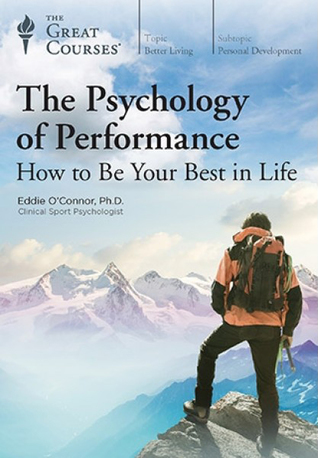
The Great Courses - The Psychology of Performance - Dr. Eddie O’Connor
Language: EnglishKeywords:
Mind
Performance
Psychology
ttc
Shared by:ihophats
Written by
Read by Dr. Eddie O’Connor
Format: MP3
Bitrate: 96 Kbps
Unabridged
In the classic joke, a New York tourist asks, “How do I get to Carnegie Hall?” The old answer: “Practice. Practice. Practice.” Today, the relatively new science of performance psychology tells us that the old answer is incomplete at best. In The Psychology of Performance: How to Be Your Best in Life, clinical sport psychologist Eddie O’Connor, Ph.D., shares the best ways for you to reach your personal Carnegie Hall based on the latest scientific research—whether your performance environment is music, dance, business, or sport. These often surprising research results will make you rethink your own performance strategies, offering approaches you might never have considered and busting myths you might have taken as truth.
In addition to the scientific research, Dr. O’Connor brings a wealth of anecdotal examples from his twenty years of clinical experience working with youth, college, international, and professional athletes; health professionals; and corporate executives. His easy-going manner, ability to make scientific theory and research results accessible to all, and numerous illustrative videos and demonstrations provide an energetic and interactive learning environment.
Sport Psychology for the Athlete and Non-Athlete
If you are an elite athlete—or aspire to become one—The Psychology of Performance will help you better benefit from your practice and identify the mental and emotional approaches that will best support your performance goals over the long term. But whether or not you have any connection to the world of sports, this course will help you achieve your personal goals in your chosen field of performance. As Dr. O’Connor explains, the work of a sport psychologist is not defined by sport, but by the science of performance psychology, the mental aspects of superior performance in settings where excellence is central—often sports, but also the performing arts, business, high-risk professions such as the military, and many other fields.
In Dr. O’Connor’s work and in this course, sport is a lens through which to view the issues of practice, anxiety, injury, confidence, and more—issues that apply to any performer. And, if you are the parent of a young athlete or performer, Dr. O’Connor will help you understand this journey from your child’s perspective and how to best support him or her along the way, too.
In these 24 exciting half-hour lectures, Dr. O’Connor explains why:
Practice might not lead to peak performance,
Excellence in anything isn’t easy or natural,
Talent is not necessary (and can even be a disadvantage),
You are not limited by genetics,
Positive thinking can get in your way, and
Being a perfectionist can help you—and hurt you.
Why 10,000 Hours Could Be Too Much—And Not Enough
Practicing an activity for 10,000 hours won’t make you great, or even good. Any person could practice shooting a basket for 10,000 hours, but that wouldn’t make him or her a great basketball player. Why not? Because contrary to what you might have heard, practice does not make perfect. Practice makes permanent. If you’re practicing incorrect technique, even two hours is too much.
Research reveals there is really only one thing that distinguishes those who achieve peak performance from everyone else: the amount of time spent in deliberate, purposeful, goal-oriented practice. This type of practice requires feedback from an expert coach, precise goals for each practice session, intense focus, and challenging yourself to consistently move forward out of your comfort zone.
Neuroscientists using brain-imaging techniques have discovered that the brains of individuals that have developed a specific skill over time differ from those without the skill. For example, in musicians, the cerebellum (a part of the brain that plays an important role in controlling body movements) is larger than in non-musicians. Similarly, there is more gray matter in three regions of the brain that plays a role in visualizing and controlling the diving movements of the body in divers than in non-divers.
If talent were the cause of these differences, they would show up in childhood before training began. But they don’t. Instead, they show up only in individuals who have dedicated themselves over time to the appropriate amount and type of practice. We’ve always known that physical training can reshape our bodies. This exciting research reveals that appropriate training can also modify the structure and function of our brains, resulting in an increased neurological ability to perform a particular skill. Purposeful practice gets you there. And it’s the only thing that can.
Mindfulness as a Performance Strategy
If you’ve never practiced mindfulness meditation, you might imagine it as a relaxation exercise on the floor at the end of a yoga class. To the contrary, Dr. O’Connor explains and demonstrates that mindfulness—paying attention in a particular way, with purpose, focused on the present moment, without judgment—can be practiced in a suit sitting in your desk chair, on the playing field, or anywhere else. Maybe you have tried a mindfulness practice and felt like a failure because you can’t seem to control your mind. In true mindfulness training, your wandering mind is not a problem; the benefit comes in actively bringing your thoughts back to focus over and over again. Constant awareness and self-correction is the point of the practice.
People have been using mindfulness techniques for at least 2,500 years and they have been widely applied in medical settings and psychotherapy. Although its use as a performance strategy is in its infancy, science has already revealed positive changes in the brain, such as automatic and improved response to emotions and improved behavioral decision-making in the face of stress, after just eight weeks of mindfulness training.
The core belief of a mindful approach is that a person performs best when maintaining a state of non-judgmental, moment-to-moment awareness and acceptance of one’s internal state, with attention focused on what is essential for performance, coupled with consistent, intentional effort that supports what the performer values most.
Conquering the Obstacles to Success
In The Psychology of Performance: How to Be Your Best in Life, you will learn how to tackle some of the greatest challenges that arise as you work towards your goals. The very first step is to clearly define those goals and your values, discovering how to shape your practice and performance as you go. Even with your path clearly defined, however, there are difficulties you will need to tackle along the way.
One of the most common roadblocks to success is performance anxiety, which you can learn to overcome through imagery techniques and other tools. A crucial thing to remember as you “get in the zone”—that psychological place where everything comes together and feels easy—is to remember to be compassionate to yourself when you don’t succeed right away. Pushing ahead and struggling will always be a part of accomplishing your goals; Dr. O’Connor teaches not only how to succeed, but how to deal with the negative parts of your journey as well, including how to identify and prevent burnout.
The relatively new field of performance psychology is helping performers around the world up their mental, emotional, and physical games in sport, dance, art, and business. With The Psychology of Performance: How to Be Your Best in Life, you, too, can aim for the top with scientifically proven theories and skills.

| Announce URL: | |
| This Torrent also has several backup trackers | |
| Tracker: | udp://tracker.open-internet.nl:6969/announce |
| Tracker: | udp://tracker.opentrackr.org:1337/announce |
| Tracker: | udp://tracker.tiny-vps.com:6969/announce |
| Tracker: | udp://tracker.vanitycore.co:6969/announce |
| Tracker: | udp://tracker.torrent.eu.org:451/announce |
| Tracker: | http://tracker.internetwarriors.net:1337/announce |
| Tracker: | http://tracker.vanitycore.co:6969/announce |
| Tracker: | http://retracker.telecom.by/announce |
| Tracker: | udp://tracker.leechers-paradise.org:6969 |
| Tracker: | udp://tracker.coppersurfer.tk:6969 |
| Tracker: | http://retracker.telecom.by:80/announce |
| Creation Date: | Wed, 17 Oct 2018 09:58:29 -0400 |
| This is a Multifile Torrent | |
| 01. Sport And Performance Psychology.mp3 21.67 MBs | |
| 02. Deliberate Practice Essential For Experts.mp3 20.75 MBs | |
| 03. How Values And Goals Drive Performance.mp3 18.46 MBs | |
| 04. The Benefits Of Mindfulness In Performance.mp3 22.92 MBs | |
| 05. When Positive Thinking Doesn’t Work.mp3 19.91 MBs | |
| 06. Acceptance And The Willingness To Feel.mp3 23.08 MBs | |
| 07. Commitment Means - no Matter What.mp3 20.4 MBs | |
| 08. Finding Internal Motivation.mp3 19.36 MBs | |
| 09. Using Imagery To Prepare For Action.mp3 20.64 MBs | |
| 10. Confidence And Self-talk.mp3 20.62 MBs | |
| 11. Developing Focused Attention.mp3 20.21 MBs | |
| 12. Superstitions, Rituals, And Routines.mp3 20.19 MBs | |
| 13. Peak Performance Getting In The Zone.mp3 22.47 MBs | |
| 14. Performance Anxiety And Choking.mp3 22.78 MBs | |
| 15. Being The Perfect Perfectionist.mp3 21.72 MBs | |
| 16. Self-compassion For Self-improvement.mp3 21.59 MBs | |
| 17. Burnout And The Need For Recovery.mp3 22.2 MBs | |
| 18. Pain Tolerance And Injury Rehabilitation.mp3 20.86 MBs | |
| 19. The Dangerous Pursuit Of The Ideal Body.mp3 21.76 MBs | |
| 20. Fan Psychology, Identification, And Violence.mp3 20.85 MBs | |
| 21. Four Qualities Of A Successful Team.mp3 21.22 MBs | |
| 22. Talent A Developmental Process.mp3 20.86 MBs | |
| 23. How To Be A Great Sport Parent.mp3 20.54 MBs | |
| 24. Aging Athletes Competing And Retiring.mp3 22.75 MBs | |
| Read Me.txt 1.36 KBs | |
| TTC The Psychology of Performance Guidebook.pdf 7.57 MBs | |
| Combined File Size: | 515.39 MBs |
| Piece Size: | 512 KBs |
| Comment: | Updated by AudioBook Bay |
| Encoding: | UTF-8 |
| Info Hash: | f4927868cabdb005ac791eb987d2778151d6f5a4 |
| Torrent Download | Torrent Free Downloads |
| Tips | Sometimes the torrent health info isn’t accurate, so you can download the file and check it out or try the following downloads. |
| Direct Download | Start Direct Download |
| Tips | You could try out alternative bittorrent clients. |
| Secured Download | Download Files Now |
| Ad |

|


This post has 6 comments with rating of 5/5
October 17th, 2018
Hmm… will check it out; thanks!
October 17th, 2018
The psychology of gratitude, ihophats.
October 17th, 2018
big thanks; this can definitely help me.
October 19th, 2018
Thank you sir, you’re a saint and a scholar!
July 29th, 2021
They want us to stop procrastinating… then they themselves release 12.5 hours of content to digest.
July 29th, 2021
Thank YOU for sharing!
Add a comment (please log in before commenting)