Renaissance: The Transformation of the West (TGC) - Jennifer McNabb
Shared by:MuftQuitab
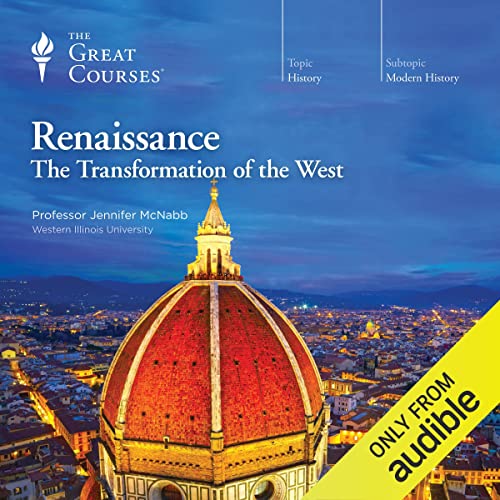
Written by
Read by Jennifer McNabb
Format: M4B
Bitrate: 64 Kbps
Unabridged
[Chapterized m4b]
While it’s easy to get caught up - and, rightfully so - in the art of the Renaissance, you cannot have a full, rounded understanding of just how important these centuries were without digging beneath the surface, without investigating the period in terms of its politics, its spirituality, its philosophies, its economics, and its societies.
Do just that with these 48 lectures that consider the European Renaissance from all sides, that disturb traditional understandings, that tip sacred cows, and that enlarges our understanding of how the Renaissance revolutionized the Western world.
Guiding you through centuries of exhilarating change in Europe with the knowledge, insights, and discernment of a master scholar, Professor McNabb offers new perspectives on familiar figures and events while focusing on often-unexplored or overlooked areas, such as the role of women in the Renaissance, the daily lives of the rural poor and urban elite, the classical roots of Renaissance thinking, and the powerful connections between the Renaissance and the Reformation.
By observing the Renaissance less casually and more critically, you’ll uncover insights and connections you can’t find in typical narratives that celebrate these remarkable, tumultuous centuries. These lectures are an authoritative, uncompromising, and multidisciplinary way to experience not just one of Europe’s Renaissance movements - but all of them.
26 hours and 35 minutes
©2018 The Great Courses (P)2018 The Teaching Company, LLC

| Announce URL: | http://tracker.files.fm:6969/announce |
| This Torrent also has several backup trackers | |
| Tracker: | http://tracker.files.fm:6969/announce |
| Tracker: | http://open.acgnxtracker.com:80/announce |
| Tracker: | http://tracker2.dler.org:80/announce |
| Tracker: | udp://exodus.desync.com:6969/announce |
| Tracker: | udp://open.stealth.si:80/announce |
| Tracker: | udp://opentor.org:2710/announce |
| Tracker: | udp://tracker.dler.org:6969/announce |
| Tracker: | udp://tracker.opentrackr.org:1337/announce |
| Tracker: | udp://tracker.tiny-vps.com:6969/announce |
| Tracker: | udp://tracker.torrent.eu.org:451/announce |
| Creation Date: | Sat, 07 Oct 2023 18:05:33 +0200 |
| This is a Multifile Torrent | |
| Renaissance - The Transformation of the West, Part 2 (25-48).m4b 378.36 MBs | |
| Renaissance - The Transformation of the West, Part 1 (1-24).m4b 368.13 MBs | |
| Renaissance guidebook.pdf 20.7 MBs | |
| Tracklist.txt 1.99 KBs | |
| Combined File Size: | 767.19 MBs |
| Piece Size: | 512 KBs |
| Comment: | Updated by AudioBook Bay |
| Info Hash: | f0317c7cea31ec6ec42e12d51d49e1a4fe19bce4 |
| Torrent Download | Torrent Free Downloads |
| Tips | Sometimes the torrent health info isn’t accurate, so you can download the file and check it out or try the following downloads. |
| Direct Download | Start Direct Download |
| Tips | You could try out alternative bittorrent clients. |
| Secured Download | Download Files Now |
| Ad |

|


This post has 4 comments with rating of 5/5
October 7th, 2023
I wonder if this book mentioned the polish thief Copernicus stealing the work of the Syrian Ibn A’Shatir
October 8th, 2023
Any proof of that, whatsoever? Is there also a corresponding obligation to mention all of the Islamic “thieves” who appropriated Greek, Jewish, Byzantine, Indian, Persian, & Syrian Christian knowledge?
Or are we all the creative, fertile product of that which went before us - cross-cultural in the best sense?
October 8th, 2023
Caesar963:
2 things happened in 1492. The fall of Granada kick-started the Renaissance.
https://muslimheritage.com/mont-saint-michel-or-toledo-greek-or-arabic-sources-for-medieval-european-culture/
https://oxfordre.com/classics/display/10.1093/acrefore/9780199381135.001.0001/acrefore-9780199381135-e-8170
There is no shame is acknowledging that other civilizations’ inventions were ‘re-invented’ by white male Europeans as taught to you as a child.
October 9th, 2023
As I said, we are all the creative, fertile product of that which went before us - cross-cultural in the best sense.
That’s my stated position. No shame in your admitting that at all, if you would.
Also, I mentioned multiple cultures which deserve credit (Greek, Jewish, Byzantine, Indian, Persian, & Syrian Christian) - the other chap mentioned Islam alone.
So, he violated your criteria, not I.
This course ought to be helpful, but the Renaissance was definitively not “kick-started” in 1492. And the source was certainly not Granada.
Discrete periodisation is always knotty, but the particular Renaissance* under discussion is located to Florence (then throughout Italy), & significantly earlier than you think.
Specifically, at the turn of the 13th/14th centuries (writings of Dante & Petrarch; paintings of Giotto). Dating goes from 1300, or 1350 to 1400, with the consequent distribution following.
The reason periodisation is a notoriously blunt instrument is demonstrated by the fact that there are enormous continuities betw the medieval era & this particular Renaissance.
On cultural crossover & sharing of ideas, many thinkers & philosophers in the Islamic world are erroneously imagined to be Muslim. The confusion is occasioned here is oft due to the fact that they come down to us with Arabic nomenclature.
Christians (& Jewish people), esp Nestorians, contributed to the Arab Islamic Civilization during the Umayyads & the Abbasids by translating works of Greek philosophers to Syriac & afterwards to Arabic. They also excelled in philosophy, science (such as Hunayn ibn Ishaq, Qusta ibn Luqa, Masawaiyh, Patriarch Eutychius, Jabril ibn Bukhtishu, etc.) & theology (Tatian, Bar Daisan, Babai the Great, Nestorius, Toma bar Yacoub, etc.) & the personal physicians of the Abbasid Caliphs were often Assyrian Christians such as the long serving Bukhtishu dynasty.
When Arabs & Islam invaded the Levant & Mesopotamia, they encountered an enormously rich intellectual culture; 600 yrs of Assyrian Christian civilisation, with a prolific heritage, a highly developed culture, & advanced learning institutions. It is this Christian Civilisation that became one of the great influences & foundations of Islamic Civilisation. The book “How Greek Science Passed to the Arabs” gives a list of the best known scholars of the Abbasid caliphate’s Golden Age. Out of theses 22 scholars, 20 were Christians (Assyrians), 1 was Persian (Zoroastrian) & 1 was Muslim.
It was a Christian scholar & Bishop from Nisibis named Severus Sebokht who was the first to describe & incorporate indian mathematical symbols in the mid 7th c, which were then adopted into Islamic culture & are now known as Arabic numerals (originally Hindu numerals, of course). Famous Persian polymath al-Khwarizmi followed in the pioneering footsteps of Diophantus of Alexandria.
Ibn Khaldun pointed out that the one civilisation from which the Arabs had learned the sciences, was that of the Greeks, thanks to the translations by Christian scholars of Greek texts into Syriac & then into Arabic. Ibn Khaldun also records that Abbasid caliph al-Mansur requested from the Byzantine Emperor the mathematical works of the Greeks.
Moreover, the field of Islamic Medicine owes its origins to two Christians, Masawaiyh & Hunayn ibn Ishaq.
All of this reinforces my point: that we’re the product of all the cultural achievements which precede us; that we’re (& I hope this doesn’t sound naïve) actually stronger together. So stop dividing us.
*There were actually multiple renaissances prior to the one being referred to: Carolingian Renaissance (8th & 9th centuries); Ottonian Renaissance (10th & 11th c), & Renaissance of 12th c. There were also regional “Golden Ages,” such as those occurring in Ireland, Northumbria, etc.
Add a comment (please log in before commenting)