Hamlet’s Mill - Giorgio de Santillana, Hertha von Dechend
Language: EnglishKeywords:
Astronomy
History
Myth
Philosophy
Precession Of The Equinox
Shared by:vootshiclone
Written by ,
Read by https://www.youtube.com/user/CulainRuledByVenus
Format: MP3
Bitrate: Variable
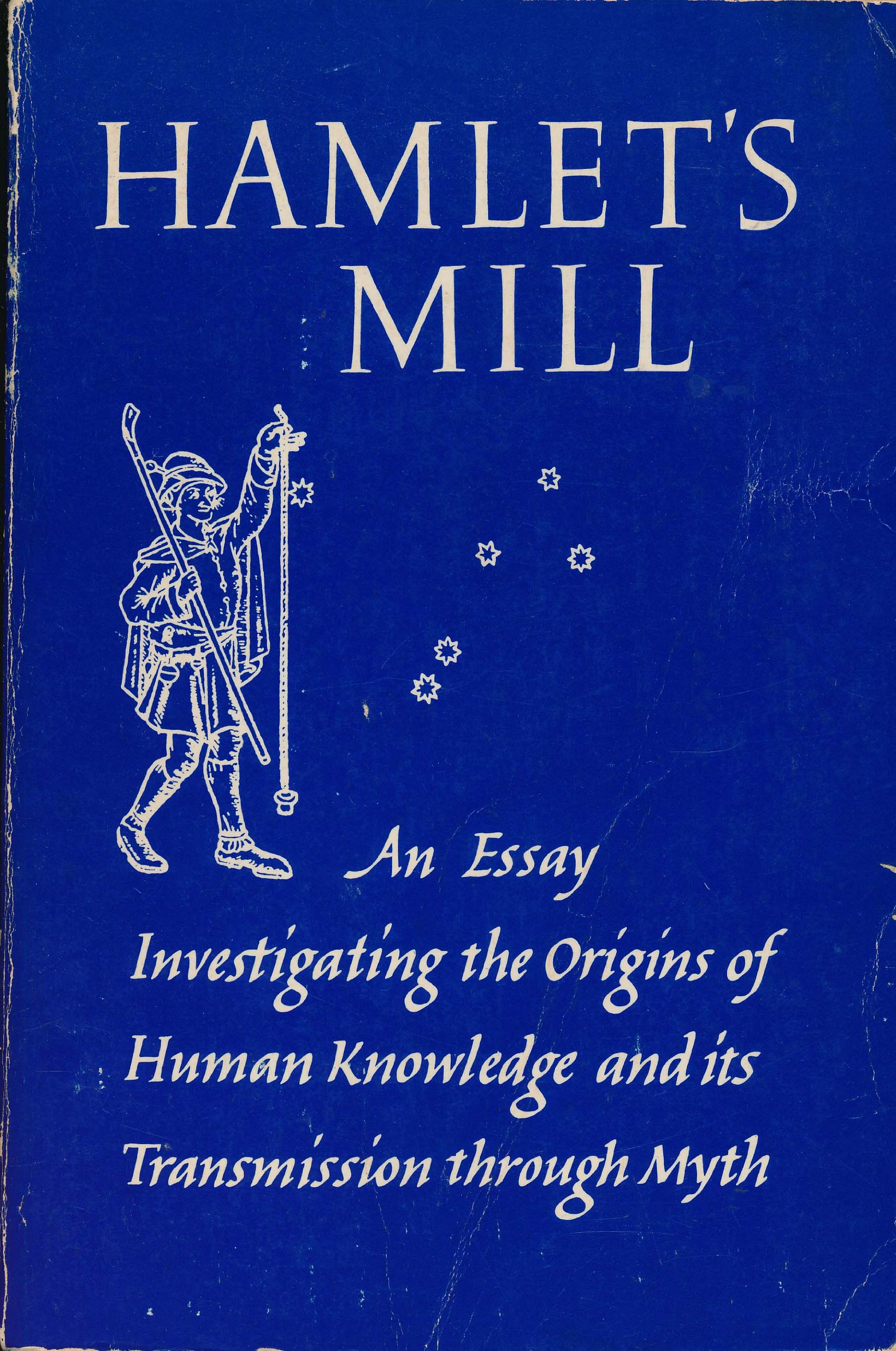
Hamlet’s Mill: An Essay Investigating the Origins of Human Knowledge and Its Transmission Through Myth (first published by Gambit, Boston, 1969) by Giorgio de Santillana (a professor of the history of science at MIT) and Hertha von Dechend (a scientist at Johann Wolfgang Goethe-Universität) is a nonfiction work of history and comparative mythology, particularly the subfield of archaeoastronomy. It is mostly about the claim of a Megalithic era discovery of axial precession, and the encoding of this knowledge in mythology. The book was severely criticized by academics upon its publication.
The main argument of the book may be summarized as the claim of an early (Neolithic) discovery of the precession of the equinoxes (usually attributed to Hipparchus, 2nd century BCE), and an associated very long-lived Megalithic civilization of “unsuspected sophistication” that was particularly preoccupied with astronomical observation. The knowledge of this civilization about precession, and the associated astrological ages, would have been encoded in mythology, typically in the form of a story relating to a millstone and a young protagonist—the “Hamlet’s Mill” of the book’s title, a reference to the kenning Amlóða kvern recorded in the Old Icelandic Skáldskaparmál.[1] The authors indeed claim that mythology is primarily to be interpreted as in terms of archaeoastronomy (”mythological language has exclusive reference to celestial phenomena”), and they mock alternative interpretations in terms of fertility or agriculture.[2]
The book’s project is an examination of the “relics, fragments and allusions that have survived the steep attrition of the ages”.[3] In particular, the book reconstructs a myth of a heavenly mill which rotates around the celestial pole and grinds out the world’s salt and soil, and is associated with the maelstrom. The millstone falling off its frame represents the passing of one age’s pole star (symbolized by a ruler or king of some sort), and its restoration and the overthrow of the old king of authority and the empowering of the new one the establishment of a new order of the age (a new star moving into the position of pole star). The authors attempt to demonstrate the prevalence of influence of this hypothetical civilization’s ideas by analysing the world’s mythology (with an eye especially to all “mill myths”) using
[…] cosmographic oddments from many eras and climes…a collection of yarns from Saxo Grammaticus, Snorri Sturluson (”Amlodhi’s mill” as a kenning for the sea!), Firdausi, Plato, Plutarch, the Kalevala, Mahabharata, and Gilgamesh, not to forget Africa, the Americas, and Oceania….[4]
Santillana and Dechend state in their introduction to Hamlet’s Mill that they are well aware of modern interpretations of myth and folklore but find them shallow and lacking insight: “…the experts now are benighted by the current folk fantasy, which is the belief that they are beyond all this - critics without nonsense and extremely wise”. Consequently, Santillana and Dechend prefer to rely on the work of “meticulous scholars such as Ideler, Lepsius, Chwolson, Boll and, to go farther back, of Athanasius Kircher and Petavius…”
They give reasons throughout the book for preferring the work of older scholars (and the early mythologists themselves) as the proper way to interpret myth; but this viewpoint did not sit well with their modern critics schooled in the “current anthropology, which has built up its own idea of the primitive and what came after”.[5]
Santillana had previously published, in 1961, The Origins of Scientific Thought, on which Hamlet’s Mill is substantially based. Compare various statements in Hamlet’s Mill to this quotation from The Origin of Scientific Thought: “We can see then, how so many myths, fantastic and arbitrary in semblance, of which the Greek tale of the Argonaut is a late offspring, may provide a terminology of image motifs, a kind of code which is beginning to be broken. It was meant to allow those who knew (a) to determine unequivocally the position of given planets in respect to the earth, to the firmament, and to one another; (b) to present what knowledge there was of the fabric of the world in the form of tales about ‘how the world began’.”[6]

| Announce URL: | http://googer.cc:1337/announce |
| This Torrent also has several backup trackers | |
| Tracker: | http://googer.cc:1337/announce |
| Tracker: | http://open.acgnxtracker.com:80/announce |
| Tracker: | http://tracker2.dler.org:80/announce |
| Tracker: | udp://exodus.desync.com:6969/announce |
| Tracker: | udp://open.stealth.si:80/announce |
| Tracker: | udp://opentor.org:2710/announce |
| Tracker: | udp://tracker.dler.org:6969/announce |
| Tracker: | udp://tracker.opentrackr.org:1337/announce |
| Tracker: | udp://tracker.tiny-vps.com:6969/announce |
| Tracker: | udp://tracker.torrent.eu.org:451/announce |
| Creation Date: | Sun, 07 Nov 2021 19:44:11 +0100 |
| This is a Multifile Torrent | |
| Hamlet’s Mill part1.mp3 389.59 MBs | |
| Hamlet’s Mill part2.mp3 256.96 MBs | |
| Hamlet’s_Mill_An_Essay_on_Myth_and_the_Frame_of_Time_Giorgio_de.pdf 100.81 MBs | |
| Combined File Size: | 747.36 MBs |
| Piece Size: | 512 KBs |
| Comment: | https://www.youtube.com/user/CulainRuledByVenus/ Updated by AudioBook Bay |
| Info Hash: | c0bd034bb2dd37ad69863d3b24d4a116d165eeb8 |
| Torrent Download | Torrent Free Downloads |
| Tips | Sometimes the torrent health info isn’t accurate, so you can download the file and check it out or try the following downloads. |
| Direct Download | Start Direct Download |
| Tips | You could try out alternative bittorrent clients. |
| Secured Download | Download Files Now |
| Ad |

|


This post has 9 comments with rating of 4.3/5
November 7th, 2021
I first read this book decades ago. Wonderful to see it in audio form! It is an absolutely brilliant (and beautifully written) work of carefully informed reinterpretation. Audacious in scope and stunning in implications. If you like Graham Hancock, etc, this is, wow! Thanks to you, Voots!
November 8th, 2021
thank you so much for this upload. I didn’t know there was an audiobook version of this, so I’m absolutely delighted.
November 8th, 2021
In the spirit of Joseph Campbell, let’s give this a try.
November 8th, 2021
This is read by that youtube channel, there is actually a professionally released version of this book on Audible tho. I will try and upload it later, gotta buy it first
November 8th, 2021
Looks most interesting. Thank you.
November 8th, 2021
My first impression is that this a Golden Bough wannabe that doesn’t quite deliver. But there still may be some interesting nuggets buried within.
November 8th, 2021
Thanks, trax0r, for uploading the professiaonally narrated Audible version:
https://audiobookbay.lu/audio-books/hamlets-mill-giorgio-de-santillana-hertha-von-dechend-4/
Greatly appreciated!
OP
November 9th, 2021
Does anyone have a copy of The Road to Eleusis? Not the audiobook, just a text? Can’t find it anywhere in english, thought someone might scan and share…
June 2nd, 2022
https://audiobookbay.lu/audio-books/the-road-to-eleusis-unveiling-the-secret-of-the-mysteries-r-gordon-wasson-albert-hofmann-carl-a-p-ruck/
Add a comment (please log in before commenting)